
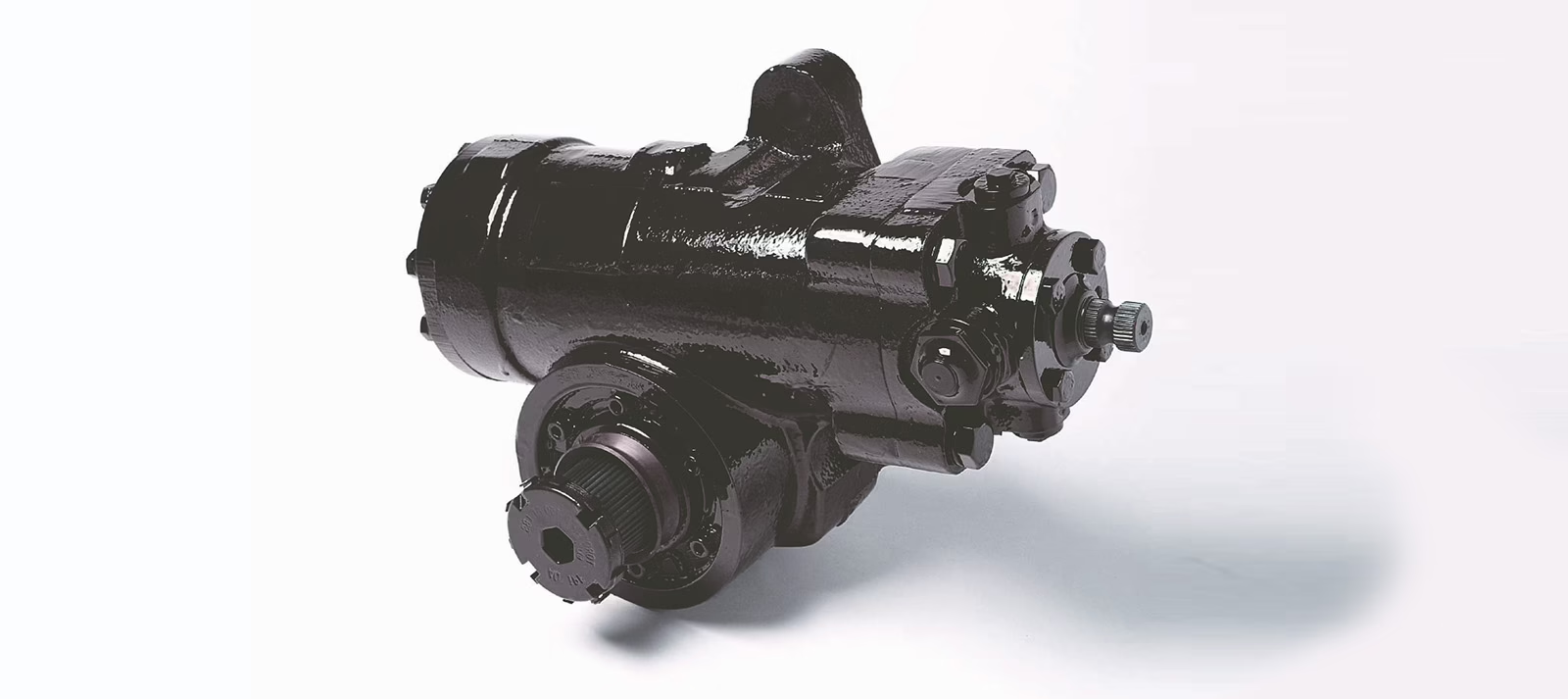
The steering gear is one of the most important and often least understood components on a heavy-duty truck.
A truck may have hundreds or even thousands of horsepower available through its engine and drivetrain, but none of that matters if the driver cannot accurately control the direction of the vehicle. On a loaded Class 8 tractor, vocational truck, refuse vehicle, fire apparatus or off-highway machine, the steering system must overcome substantial tire loading while still providing predictable road feel and precise control.
Modern heavy-duty truck steering gears accomplish this by combining a mechanical reduction mechanism with hydraulic—or increasingly electronic—assistance.
For decades, manufacturers such as RH Sheppard, Ross/TRW, ZF, Gemmer and Saginaw have developed steering systems capable of handling the high front-axle loads found in commercial vehicles. Two names in particular have become deeply associated with North American heavy-duty steering: RH Sheppard and Ross/TRW.
Understanding how these gears developed, how they operate internally and how the various designs differ can make steering-system diagnosis, replacement and parts identification significantly easier.
What Is a Heavy-Duty Truck Steering Gear?
The steering gear, often called a steering gearbox, converts the driver’s rotation of the steering wheel into movement of the truck’s steering linkage.
In a conventional heavy-duty truck steering system, the basic mechanical path is:
Steering Wheel → Steering Column → Steering Gear Input Shaft → Steering Gear → Sector Shaft → Pitman Arm → Drag Link → Steering Arm → Steering Knuckle → Tie Rod → Steered Wheels
The steering gear performs two major jobs.
First, it changes the driver’s rotary steering-wheel movement into movement capable of turning the front wheels.
Second, it provides mechanical advantage and, on power-steering systems, hydraulic assistance so the driver does not have to overcome the entire steering load manually.
On modern commercial trucks, the steering gear is typically an integral hydraulic recirculating-ball steering gear.
TRW describes its TAS and THP products as integral hydraulic gears because the mechanical steering mechanism, hydraulic control valve and hydraulic power cylinder are incorporated into one compact assembly.
Is the Steering Gear Part of the Driveline?
Technically, no. The steering system is part of the vehicle’s chassis and steering system, not the driveline.
The driveline transfers propulsion torque:
Engine → Clutch/Torque Converter → Transmission → Driveshaft → Differential → Axle Shafts → Wheels
The steering system controls wheel direction:
Steering Wheel → Steering Column → Steering Gear → Steering Linkage → Steering Knuckles → Wheels
The two systems interact physically, however.
A conventional hydraulic power-steering pump is usually driven by the engine, meaning that the power required to operate the steering system ultimately originates from the powertrain. The steering gear itself is also mounted near the front axle and steering linkage, so the steering, suspension and drivetrain occupy the same general area of the chassis.
This is why steering components are frequently grouped alongside driveline and chassis products in the heavy-duty aftermarket even though the steering gear does not transmit propulsion torque.
A Brief History of Heavy-Duty Truck Steering
Early trucks relied almost entirely on mechanical steering.
As trucks grew larger, front axle capacities increased and vehicle weights climbed, manually turning the wheels became increasingly demanding. Steering systems therefore evolved through several major stages:
- Mechanical steering gears
- Hydraulic power-assist systems
- Integral hydraulic power steering
- Dual-gear and hydraulic assist systems
- Electronically controlled hydraulic steering
- Active steering and electric steering technologies
The fundamental goal has remained the same: reduce driver effort while maintaining mechanical reliability and accurate vehicle control.
Early Mechanical Steering Gears
Before widespread hydraulic power steering, steering-wheel movement was transmitted mechanically through a reduction gearbox.
Historical steering mechanisms included variations of:
- Worm-and-sector
- Worm-and-roller
- Cam-and-lever
- Recirculating-ball
- Screw-and-nut mechanisms
Gear reduction multiplied the driver’s input torque.
The disadvantage was effort.
A heavily loaded steer axle could place enormous resistance against the tires when the vehicle was stationary or traveling at low speed. Drivers sometimes needed considerable physical force to maneuver early heavy trucks.
Power steering changed that dramatically.
The Development of Hydraulic Power Steering
Hydraulic assistance allowed fluid pressure to supply much of the force required to steer the front wheels.
Early systems could use a conventional mechanical steering gear combined with an external hydraulic assist cylinder.
Later designs incorporated the hydraulic control mechanism and power cylinder directly into the steering gearbox.
That architecture became known as integral hydraulic power steering and remains one of the dominant designs in heavy commercial trucks.
A typical hydraulic system consists of:
- Power steering pump
- Fluid reservoir
- Pressure hose
- Return hose
- Steering gear
- Internal rotary control valve
- Hydraulic piston
- Mechanical steering mechanism
- Pitman arm and steering linkage
The pump supplies both fluid flow and pressure capability.
Those two concepts perform different jobs.
Steering Flow Controls Speed
Hydraulic flow determines how quickly the steering gear can move.
More fluid volume allows the piston inside the steering gear to move faster, enabling the driver to turn the wheels more quickly.
Steering Pressure Controls Force
Pressure determines how much force the system can produce against steering resistance.
TRW summarizes the relationship as essentially pressure means work and flow means speed. Its TAS/THP documentation explains that the control valve directs the required fluid flow and pressure to the appropriate side of the steering gear piston during a steering maneuver.
That distinction is extremely important when diagnosing a heavy-duty steering complaint.
Low flow may produce slow steering.
Insufficient pressure may produce high steering effort, particularly at low vehicle speeds.
How an Integral Hydraulic Steering Gear Works
Although manufacturer designs differ in detail, a modern RH Sheppard or Ross/TRW steering gearbox operates using similar basic principles.
Step 1: The Driver Turns the Steering Wheel
Steering-wheel rotation travels through the steering column and universal joints to the steering gear input shaft.
Inside the gear is a torsion element and rotary hydraulic valve.
With the steering wheel centered, the valve remains near its neutral position and hydraulic fluid circulates through the system at relatively low pressure.
Step 2: Steering Resistance Twists the Torsion Bar
When the driver begins turning, resistance from the tires prevents the steering mechanism from immediately following the steering wheel.
The resulting torque slightly twists a torsion bar inside the control-valve mechanism.
That movement shifts the rotary valve.
The amount the valve opens corresponds to how much assistance the driver needs.
Light steering resistance requires relatively little hydraulic pressure.
Heavy steering resistance causes the valve to direct greater hydraulic pressure to the piston.
Step 3: Hydraulic Pressure Moves the Piston
The control valve sends pressurized steering fluid to one side of the internal piston.
Fluid on the opposite side is allowed to return toward the reservoir.
Hydraulic pressure therefore pushes the piston through the steering gear’s cylinder bore.
RH Sheppard describes its M-Series as a full-time hydraulic system in which rotating the input shaft causes pressure to build on one side of the piston, moving it through the housing.
What Is a Recirculating-Ball Steering Gear?
Most traditional heavy-duty truck steering gears use some form of recirculating-ball mechanism.
Instead of allowing a threaded worm and nut to slide directly against each other, hardened steel balls circulate through tracks between the worm shaft and piston or ball nut.
As the worm rotates:
- Balls travel through the helical grooves.
- The ball nut or rack piston moves longitudinally.
- The balls circulate back through return passages.
- Linear piston movement is converted into sector-shaft rotation.
The design dramatically reduces sliding friction while supporting substantial load.
Sheppard’s M-Series documentation, for example, describes a rotary-valve shaft operating within the piston through steel recirculating balls.
From Rack Piston to Pitman Arm
Moving the hydraulic piston alone would not steer the truck.
One side of the piston incorporates rack teeth.
Those teeth engage a toothed section of the sector shaft.
The movement therefore becomes:
Hydraulic Piston Moves Linearly → Rack Teeth Rotate Sector Shaft
The external end of the sector shaft carries the pitman arm.
The pitman arm then moves the drag link.
The drag link moves the steering arm attached to the steering knuckle.
The tie rod keeps the left and right steering wheels moving together at the correct relationship.
The complete mechanical path can therefore be visualized as:
Steering Wheel
↓
Steering Column
↓
Input Shaft / Rotary Valve
↓
Recirculating Ball Mechanism
↓
Hydraulic Rack Piston
↓
Sector Shaft
↓
Pitman Arm
↓
Drag Link
↓
Steering Knuckle
↓
Tie Rod
↓
Front Wheels
Hydraulic Assistance Does Not Eliminate the Mechanical Connection
A particularly important feature of conventional heavy-duty steering gears is that hydraulic pressure assists the mechanical system rather than completely replacing it.
Sheppard states that its M-Series gears are designed with mechanical backup steering if hydraulic pressure is suddenly lost while driving. Steering effort becomes substantially greater, but the mechanical connection remains.
This mechanical continuity has historically been one of the reasons recirculating-ball hydraulic steering gears became so successful in commercial vehicles.
Steering Gear Relief Plungers and Poppet Valves
A heavy-duty truck should not continue applying full hydraulic steering force once the wheels have reached their mechanical steering stops.
Doing so could:
- Overheat the hydraulic fluid
- Increase pump load
- Damage steering linkage
- Stress axle stops
- Damage seals
- Increase hose pressure unnecessarily
Manufacturers therefore use relief or unloading mechanisms.
TRW TAS/THP gears incorporate unloading or poppet valves that reduce hydraulic pressure as the steered wheels approach their axle stops.
Sheppard uses relief plungers for a similar purpose. Properly adjusted plungers allow full wheel cut while preventing full hydraulic force from continuously driving the axle stops together.
This is why steering-stop and poppet/plunger adjustment can be important after:
- Steering gear replacement
- Front axle replacement
- Alignment changes
- Pitman arm replacement
- Steering linkage modifications
Major Types of Heavy-Duty Truck Steering Systems
1. Manual Mechanical Steering
Manual steering relies entirely on mechanical leverage and gear reduction.
It is mechanically simple but requires considerable driver effort on heavy front axles.
Today it is largely obsolete in modern Class 7 and Class 8 highway trucks.
2. Hydraulic Power-Assist Steering
A power-assist system retains a largely mechanical steering gearbox but adds an external hydraulic cylinder.
The cylinder assists movement of the linkage.
These systems were an important stage in the development of truck power steering and can still be encountered in older vehicles and specialty applications.
3. Integral Hydraulic Power Steering
This is the system most people mean when discussing a modern truck power steering gearbox.
The housing contains:
- Mechanical reduction mechanism
- Recirculating-ball assembly
- Hydraulic piston
- Control valve
- Sector shaft
- Relief system
RH Sheppard M-Series and D-Series gears and Ross/TRW TAS and THP designs are examples of the heavy-commercial evolution of integral hydraulic steering.
4. Dual Steering Gear Systems
Extremely heavy front axle applications may require more steering force than a single gear can efficiently provide.
A dual steering system can use:
- One master steering gear and one slave gear, or
- One steering gear with an auxiliary hydraulic cylinder.
TRW documentation identifies master/auxiliary combinations including TAS/RCS and older HFB/RCB systems, with significantly greater hydraulic flow requirements than a single steering gear.
Sheppard likewise provides steering configurations designed for multiple-gear applications.
These systems are common on vehicles with exceptionally heavy steer-axle loads such as:
- Concrete mixers
- Heavy wreckers
- Cranes
- Refuse trucks
- Fire apparatus
- Heavy vocational trucks
- Specialty multi-axle vehicles
5. Electrohydraulic Steering
Electrohydraulic systems still use hydraulic pressure at the steering actuator but replace or supplement an engine-driven hydraulic pump with an electrically driven pump.
Potential advantages include:
- Hydraulic power only when required
- Reduced parasitic engine load
- Greater integration with vehicle electronics
- Better compatibility with hybrid and battery-electric vehicles
Traditional engine-driven pumps consume some engine power whenever they operate. An electrically driven pump can provide hydraulic assistance independently of engine speed.
6. Active Steering and Torque-Overlay Systems
Modern driver-assistance systems require the steering system to do more than simply respond to driver input.
Electronic actuators can add small amounts of steering torque to support functions such as:
- Lane keeping
- Lane centering
- Crosswind compensation
- Steering stabilization
- Driver-assistance interventions
This development is particularly important in heavy trucks because conventional hydraulic steering systems were originally designed for manual driver control rather than computer-commanded steering.
The 2020 acquisition of RH Sheppard by Bendix parent Knorr-Bremse specifically highlighted the value of combining Sheppard’s recirculating-ball steering expertise with electronic braking and driver-assistance technologies to develop torque-overlay steering and automated-driving functions.
7. Fully Electric and Steer-by-Wire Technologies
Commercial steering is gradually moving toward greater electrification.
ZF has developed ReAX-e, a fully electric steering actuator intended to replace hydraulic assistance in applicable commercial-vehicle architectures, while steering technologies are increasingly being designed to support ADAS and automated-driving functions.
Fully electric steering offers several potential advantages:
- No hydraulic pump
- No steering-fluid reservoir
- No hydraulic hoses
- Reduced parasitic losses
- Easier integration with electric vehicles
- Electronic steering assistance
- ADAS compatibility
However, the extremely high steering forces and safety requirements of heavy Class 8 and severe-duty trucks mean that traditional hydraulic recirculating-ball steering continues to play an important role.
RH Sheppard: A Major Name in Heavy-Duty Steering
Few companies are as closely associated with North American heavy-truck steering as R.H. Sheppard Co.
Interestingly, the company did not begin with steering gears.
RH Sheppard traces its history to 1937 in Hanover, Pennsylvania, where founder R.H. Sheppard pursued diesel-engine development. The company manufactured multiple diesel-engine designs used in applications ranging from generators and pumps to farm tractors.
Steering eventually became the company’s defining product.
1953: Sheppard Enters Power Steering
RH Sheppard states that its first power steering gear was installed on a Sheppard SD-4 tractor in 1953.
The technology soon migrated toward heavy trucks.
By 1963, Sheppard had committed its engineering and manufacturing resources to power steering.
The Sheppard M-Series
One of the most important developments in the company’s history was the introduction of the M-Series in 1986.
M-Series steering gears became widely used throughout the North American commercial vehicle industry.
Common Sheppard families encountered in the aftermarket include models such as:
- M83
- M90
- M100
- M110
The M110, for example, is designed for heavy-duty vocational truck and bus applications with front axle ratings in the 16,000-20,000 lb range.
Sheppard emphasizes several characteristics of its steering-gear architecture, including fully ground rack-and-sector surfaces and a tapered-spline sector output connection.
Sheppard D-Series Steering Gears
Sheppard later developed its D-Series to improve steering feel, on-center stiffness, return characteristics, durability and packaging.
Current Sheppard commercial steering families include models such as:
- MD83
- HD94
- M100
- M110
- SD110
- XD120
Sheppard describes the D-Series as having a quicker steering ratio and improved on-center steering feel intended to reduce wandering and driver fatigue.
Who Owns RH Sheppard Today?
The corporate history is noteworthy because it connects several major commercial-vehicle technology companies.
Bendix Commercial Vehicle Systems, part of Knorr-Bremse, completed the acquisition of R.H. Sheppard in June 2020.
The transaction occurred when WABCO was being acquired by ZF and Sheppard was divested in connection with that transaction.
Today, the Sheppard brand remains one of the most recognizable names in North American heavy-duty steering.
How to Identify an RH Sheppard Steering Gear
Model identification is critical when replacing a heavy-duty steering gearbox because gears that look similar externally may have different:
- Steering ratios
- Mounting configurations
- Pitman-arm positions
- Hydraulic ports
- Relief settings
- Rotation
- Input configurations
- Sector-shaft specifications
Sheppard provides several useful identification clues.
According to Sheppard’s core-identification guide:
- Sheppard output shafts use a tapered spline without the circumferential groove found on many TRW units.
- Sheppard commonly uses hex-style housing bolts where corresponding TRW designs may use Torx fasteners.
- The Sheppard name is cast into the housing.
- Family numbers such as M90, M100, M110, HD94 and others may appear in the casting or stamped identification.
The complete stamped model number should always be used whenever possible rather than identifying a gear solely by appearance.
Ross Steering: More Than a Century of Truck Steering History
The Ross name reaches even further back into American steering history.
David E. Ross began developing automotive gearing in the early twentieth century and helped establish the Ross Gear and Tool Company in Lafayette, Indiana, in 1906. Purdue University’s archives document Ross’s extensive development work in automotive gears and steering systems.
Ross Gear quickly became an important automotive and truck component supplier.
In 1919, Fairfield Manufacturing was formed to focus on differential gearing while Ross Gear and Tool increasingly concentrated on steering products.
Ross steering gears were used in military trucks during World War I and later across numerous vehicle applications.
Ross and ZF: A Relationship Dating to 1932
An interesting part of the Ross story is its connection to ZF.
ZF’s corporate history states that in 1932 it obtained an exclusive European license for Ross steering systems.
That relationship ultimately came full circle decades later.
Ross Becomes Part of TRW
Ross Gear & Tool was acquired by TRW in 1964.
The following year, Thompson Ramo Wooldridge formally adopted the shorter corporate name TRW.
From that point forward, the Ross steering heritage became closely associated with TRW commercial steering products.
That is why the heavy-duty aftermarket frequently uses the combined designation:
Ross/TRW steering gear
Older trucks may carry Ross-branded gear families while later vehicles use TRW-branded successors.
From Ross/TRW to ZF
ZF acquired TRW Automotive in 2015, adding TRW’s steering, braking, safety and driver-assistance technologies to the ZF organization.
The historical progression is therefore:
Ross Gear & Tool → TRW → ZF
Interestingly, ZF had already been licensing Ross steering technology in Europe since 1932, making the 2015 acquisition a reconnection of two companies whose steering histories had intersected more than 80 years earlier.
Important Ross/TRW Heavy-Duty Steering Gear Families
Technicians working on older and current commercial vehicles may encounter several Ross/TRW families.
These include:
- HF
- HFB
- RCB
- TAS
- RCS
- THP
HFB and RCB
HFB-series gears were widely used integral hydraulic steering gears.
In dual systems, an HFB master gear could be paired with an RCB rotary cylinder/slave gear.
TRW technical literature, for example, lists HFB70/RCB70 and HFB70/RCB64 combinations for dual steering applications.
TRW TAS Steering Gears
The TAS family became one of TRW’s best-known commercial steering designs.
Common family sizes include:
- TAS40
- TAS55
- TAS65
- TAS85
TAS gears are integral hydraulic recirculating-ball steering gears designed for medium- and heavy-front-axle commercial applications.
ZF/TRW describes TAS designs as using relatively few moving parts while providing strong torque output for medium- and heavy-duty vehicles.
TRW THP Steering Gears
The THP, or high-pressure family, represents a later evolution of the TAS architecture.
TRW documentation explains that THP designs were developed with:
- Reduced package size
- Reduced weight
- Faster steering ratios
- Lower internal friction
- Better return to center
- Higher pressure capability
- Improved steering feel
The design was based on proven TAS technology with changes intended to improve handling and packaging.
For fleets and parts departments, that means visually similar steering gears cannot automatically be substituted. Exact application, mounting, ratio, pressure requirements and OEM specifications matter.
RH Sheppard vs. Ross/TRW Steering Gears
Both manufacturers produce highly capable heavy-commercial steering systems, but their designs should not be treated as universally interchangeable.
Some of the key differences can include:
| Feature | RH Sheppard | Ross/TRW |
|---|---|---|
| Common Families | M-Series, D-Series | HF, HFB, RCB, TAS, RCS, THP |
| Primary Technology | Integral hydraulic / recirculating-ball | Integral hydraulic / recirculating-ball |
| Output Connection | Sheppard tapered-spline design | TRW-specific sector-shaft designs |
| Relief System | Relief plungers | Poppet/unloading valves |
| Heavy-Duty Applications | Yes | Yes |
| Dual-System Capability | Yes | Yes |
| Remanufactured Availability | Extensive | Extensive |
Exact model identification should always take precedence over a broad manufacturer comparison.
Other Important Heavy-Duty Steering Manufacturers
Although Sheppard and Ross/TRW are especially prominent, heavy truck steering history includes numerous other brands.
Depending on vehicle age and application, technicians may encounter:
- Gemmer
- Saginaw
- ZF
- Eaton
- Bendix
- Garrison
- Parker
- Vickers
- R.H. Sheppard
- Ross
- TRW
Some names are more strongly associated with steering gears themselves, while others became important suppliers of pumps, hydraulic controls and related steering-system components.
General Truck Parts supports new and remanufactured steering gears and pumps across many of these product families.
The Power Steering Pump Is Just as Important as the Gear
A steering gearbox cannot create hydraulic assistance without an adequate supply from the power steering pump.
The pump must provide the correct:
- Flow
- Pressure
- Direction
- Fluid supply
- Reservoir capacity
Installing a steering gear with the wrong pump specification can lead to:
- High steering effort
- Slow steering response
- Excessive hydraulic temperature
- Pump noise
- Cavitation
- Seal damage
- Premature steering-gear failure
Dual-gear systems require substantially more flow than single-gear systems. TRW flow charts, for example, show a TAS65 single gear requiring substantially less pump flow than TAS/RCS dual systems.
Correct application matching therefore involves the entire steering hydraulic circuit, not just the steering box.
Common Heavy-Duty Steering Gear Failure Symptoms
A steering complaint does not automatically mean the steering gearbox has failed.
Common symptoms include:
Hard Steering
Possible causes include:
- Low hydraulic fluid
- Restricted filter
- Weak power steering pump
- Incorrect pump pressure
- Low pump flow
- Air in the system
- Restricted hydraulic hose
- Seized kingpins
- Steering linkage binding
- Internal steering-gear wear
Excessive Steering Play
Potential causes include:
- Worn drag-link ends
- Tie-rod wear
- Loose pitman arm
- Steering-column wear
- Kingpin wear
- Wheel bearing play
- Steering-gear internal wear
- Loose mounting hardware
Never assume free play originates in the steering gear until the rest of the steering linkage is inspected.
Steering Fluid Leakage
Common leakage points can include:
- Input shaft seals
- Sector shaft seals
- Housing seals
- End-cap seals
- Hydraulic hoses
- Pump seals
- Reservoir fittings
Some heavy-duty gears can be repaired with seal kits rather than requiring complete replacement. Sheppard specifically emphasizes on-vehicle seal replacement as part of its service philosophy.
Steering Wheel Kickback
Road shock transmitted back through the linkage can create steering-wheel kick.
Integral hydraulic gears are designed to help absorb these forces. TRW describes how shock loads entering through the sector shaft and piston cause the hydraulic valve to direct pressure in a way that resists objectionable kickback.
Severe kickback may therefore indicate problems elsewhere in the steering or hydraulic system.
Why Pressure and Flow Testing Matters
Before replacing an expensive steering gearbox, technicians should verify the hydraulic system.
A proper pressure and flow test helps distinguish between:
- Steering gear failure
- Pump failure
- Hydraulic restriction
- Flow deficiency
- Pressure deficiency
This is especially important because a weak pump can produce symptoms nearly identical to an internally worn steering gear.
Sheppard’s service resources specifically include pressure-and-flow testing as part of steering troubleshooting and technician training.
Remanufactured Heavy-Duty Steering Gears
Because commercial steering gears are substantial precision assemblies, remanufacturing can provide an economical alternative to purchasing new.
A quality remanufacturing process should typically include:
- Complete disassembly
- Thorough cleaning
- Housing inspection
- Shaft inspection
- Bearing inspection
- Replacement of seals and wear components
- Inspection of rack and sector surfaces
- Valve inspection
- Reassembly to specification
- Hydraulic testing
- Leak testing
- Functional load testing
Testing is particularly important.
A steering gear that appears acceptable on a workbench may behave differently when subjected to operating pressure and steering load.
General Truck Parts stocks more than 1,000 new and remanufactured power steering gears and pumps, including products associated with RH Sheppard, Ross, TRW, ZF, Gemmer, Saginaw and other heavy-duty steering manufacturers. Remanufactured steering gears and pumps are tested under load on a dedicated test stand, and custom steering-gear and pump remanufacturing is also available.
How to Identify the Correct Replacement Steering Gear
Heavy-duty steering gear identification can be more complicated than matching the basic casting.
Two gears from the same family may differ in:
- Mounting orientation
- Steering ratio
- Input-shaft configuration
- Sector-shaft diameter
- Sector-shaft spline
- Pitman-arm location
- Hydraulic-port configuration
- Rotation
- Relief-plunger setup
- Pressure rating
- Vehicle application
Whenever possible, provide:
- Manufacturer
- Complete steering gear model number
- Stamped specification number
- Truck make
- Truck model
- Model year
- VIN
- Front axle rating
- Photos of the steering gear
- Pitman-arm orientation
- Hydraulic-port locations
A casting number alone may identify only the housing family rather than the exact steering-gear specification.
Steering Gear vs. Steering Rack: What Is the Difference?
Passenger cars and lighter vehicles commonly use a rack-and-pinion steering assembly.
Heavy trucks traditionally use a steering gearbox with a pitman arm.
The reason is primarily load capacity and packaging.
A heavy-duty recirculating-ball steering gear can produce very high output torque while fitting alongside the truck frame rail and connecting efficiently to traditional heavy-duty steering linkage.
Modern electric and integrated steering technologies are changing this distinction, but conventional steering boxes remain widespread in medium- and heavy-duty commercial vehicles.
Why Heavy-Duty Trucks Still Use Recirculating-Ball Steering
Recirculating-ball systems may seem old compared with modern passenger-car electric steering racks, but the design offers several advantages for heavy commercial vehicles:
- Very high output torque
- Strong mechanical construction
- Excellent durability
- Compact frame-rail mounting
- Mechanical steering continuity
- Compatibility with very high axle loads
- Ability to operate dual steering systems
- Established service infrastructure
- Extensive remanufacturing support
The design has evolved considerably through improved:
- Hydraulic pressures
- Gear geometry
- Bearings
- Seal technology
- Steering ratios
- Materials
- Valve designs
- Electronic assistance
The modern heavy-truck steering gearbox is therefore far more sophisticated than the mechanical steering boxes from which it evolved.
The Future of Heavy-Duty Truck Steering
Commercial vehicles are entering another major steering transition.
Future steering systems will increasingly need to satisfy three objectives simultaneously:
High steering force
Low energy consumption
Electronic controllability
Advanced driver-assistance and automated-driving functions require steering systems capable of receiving electronic commands while still providing safe, predictable driver control.
That is driving development in:
- Torque-overlay steering
- Electric power assist
- Electrohydraulic pumps
- Active steering
- Rear-axle steering
- Steer-by-wire
- Redundant steering actuators
At the same time, conventional hydraulic steering will remain important for a large installed population of commercial trucks for many years.
That means fleets, repair facilities and parts suppliers will continue supporting generations of:
- RH Sheppard M-Series
- Sheppard D-Series
- Ross HF and HFB
- Ross/TRW RCB
- TRW TAS
- TRW THP
- ZF commercial steering
- Gemmer
- Saginaw
- Other legacy and specialty systems
Frequently Asked Questions About Heavy-Duty Truck Steering Gears
What does a truck steering gear do?
The steering gear converts rotation of the steering wheel into movement of the steering linkage. In a hydraulic system, it also uses pressurized fluid to reduce the amount of force the driver must apply.
Are steering gears hydraulic?
Most conventional modern heavy-duty truck steering gears are integral hydraulic power steering gears, although mechanical, power-assist, electrohydraulic and electric systems also exist.
What is inside a heavy-duty steering gearbox?
Typical components include:
- Input shaft
- Torsion bar
- Rotary control valve
- Worm/ball-thread shaft
- Recirculating balls
- Rack piston
- Sector shaft
- Bearings
- Hydraulic seals
- Relief plungers or poppet valves
- Pressure-relief components
What is a recirculating-ball steering gear?
A recirculating-ball steering gear uses steel balls traveling through helical grooves between the worm shaft and piston or ball nut. The balls reduce friction while transferring force through the steering mechanism.
What is the difference between RH Sheppard and TRW steering gears?
Both companies manufacture integral hydraulic steering gears for commercial vehicles, but their internal designs, sector shafts, mounting arrangements, relief systems and model specifications differ. Exact model numbers should always be verified before replacement.
What are common RH Sheppard steering gear models?
Common heavy-duty families include M-Series gears such as M90, M100 and M110, along with newer D-Series families such as MD83 and HD94 and larger specialty configurations.
What are common Ross/TRW steering gear families?
Common product families include:
- HF
- HFB
- RCB
- TAS
- RCS
- THP
The TAS and THP families represent later generations of TRW integral hydraulic commercial steering technology.
Can a heavy-duty steering gear be remanufactured?
Yes. Many commercial steering gears are excellent candidates for remanufacturing if the housing and critical hard parts remain serviceable. Proper remanufacturing requires inspection, component replacement, precise reassembly and hydraulic load testing.
What causes hard steering on a semi truck?
Hard steering may result from the steering gear, but other common causes include:
- Weak power steering pump
- Low fluid
- Air in the hydraulic system
- Restricted hoses
- Incorrect flow
- Low hydraulic pressure
- Seized kingpins
- Binding steering linkage
Pressure and flow testing should generally be performed before condemning the steering gear.
Can the truck still steer if hydraulic power is lost?
Traditional integral hydraulic steering gears retain a mechanical connection between the steering wheel and steering linkage. Steering effort increases significantly without hydraulic pressure, but systems such as the Sheppard M-Series are designed to retain mechanical backup capability.
Heavy-Duty Steering Gear Parts and Support
From the earliest mechanical Ross steering gears to modern RH Sheppard, TRW and ZF power-steering systems, the steering gearbox has evolved into one of the most sophisticated mechanical and hydraulic components on a commercial vehicle. Despite major advances in hydraulics and electronics, its purpose remains straightforward: Translate the driver’s command into controlled movement of the wheels—reliably, accurately and safely.
For fleets and repair facilities, correct steering-gear identification is critical. Model number, mounting configuration, front-axle capacity, hydraulic requirements, pitman-arm orientation and vehicle application should all be verified before ordering.
General Truck Parts & Equipment supplies new and remanufactured heavy-duty steering gears, power steering pumps and related components for RH Sheppard, Ross/TRW, ZF, Gemmer, Saginaw and other commercial steering systems, with hundreds of steering-gear listings available for heavy-duty truck and off-highway applications.
Whether servicing a legacy Ross HFB gearbox, a TRW TAS or THP unit, an RH Sheppard M-Series gear or a newer heavy-duty steering system, accurate identification and properly tested replacement components are essential to keeping commercial vehicles steering safely and reliably. Heavy-duty steering has changed dramatically over more than a century—but precision, durability and control remain the foundation of every successful steering system. Contact us today to learn more.
Recent Knowledge Base Articles

How Camshafts Work

How Allison Transmissions Work

Heavy-Duty Truck Steering Gears: From Mechanical Gearboxes to Modern Power Steering

Detroit Diesel Series 60 Engine
Heavy-Duty Hydraulic Pumps Explained

Eaton Fuller Roadranger Transmission Model Breakdown
Heavy-Duty Turbochargers Now Available from General Truck Parts

General Truck Parts Announces Master Distributor Partnership with AFA Industries to Expand Heavy-Duty Engine Solutions
Fabco: A Legacy in Heavy-Duty Drivelines and Transfer Cases
The Universal Joint: The Connecting Link of the Heavy-Duty Truck Driveline
Contact Us Today
Our Experts are available to answer your questions and help you with your needs.
We take pride in getting you your answers, parts, and assemblies fast.
 | 800-621-3914 |